
Your Tattoo License Is One Missing Document Away from Being Revoked
Aug 02, 2026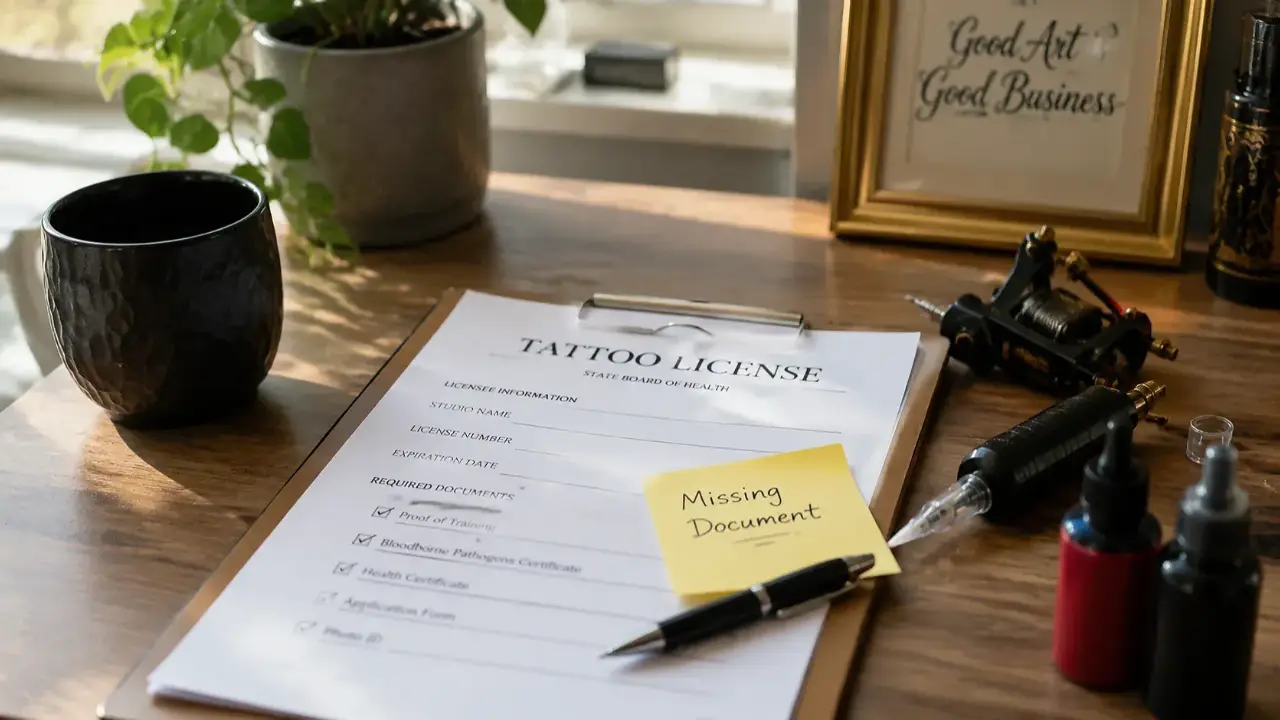
Most California tattoo artists walk into work every day believing their paperwork is solid. The permit is posted. The studio passed its last inspection. Their hands know the gloves-first protocol before their brain has even finished the first cup of coffee. Then a county health inspector walks through the door, asks to see the bloodborne pathogen certificate, and everything that felt airtight suddenly isn't. Tattoo license requirements in California BBP documentation are more specific — and more time-sensitive — than most artists realize until that moment arrives.
Understanding exactly what the California body art practitioner registration demands, and why the BBP certificate is the linchpin holding it together, is not bureaucratic housekeeping. It is the difference between a business that keeps running and one that gets shut down on a Tuesday morning in front of a waiting client.
What the California Body Art Practitioner Registration Actually Requires
The California Safe Body Art Act — Assembly Bill 300, later amended by AB1168 — established a statewide licensing framework for tattoo artists, body piercers, permanent makeup artists, and microblading technicians. Before the Act, regulation was handled county-by-county with wildly inconsistent standards. The law created a floor: certain requirements now apply everywhere in the state, regardless of whether you work in Fresno, Bakersfield, or a coastal city.
To operate legally as a body art practitioner in California, you must hold a current registration with your county health department. That registration is not a one-time application. It requires renewal, and one of the hard conditions for initial registration and annual renewal is a current bloodborne pathogen training certificate.
The specific documents you need to have current at all times include:
- A valid bloodborne pathogen (BBP) training certificate from a recognized provider
- Proof of hepatitis B vaccination or a signed declination waiver
- Current county body art practitioner registration
- Your studio's current body art facility permit (this is the studio's license, separate from yours)
Each of these has its own expiration and its own renewal process. Missing any one of them can jeopardize your registration — and your ability to legally work.
Why BBP Certification Is a Hard Requirement, Not a Formality
There is a category of professional requirements that feel optional until they are not. For a long time, in California's patchwork of county-by-county regulations, bloodborne pathogen training existed in a gray zone where some counties enforced it aggressively and others barely checked. The Safe Body Art Act ended that gray zone.
Under the current framework, bloodborne pathogen training is a hard legal requirement for registration. The California Department of Public Health mandates that body art practitioners complete BBP training that meets or exceeds the federal OSHA Bloodborne Pathogens Standard (29 CFR 1910.1030). It must be completed annually — not every two years, not "when you can get to it," but once every calendar year.
This is not a courtesy suggestion. County health departments are required to verify BBP compliance as part of the registration and inspection process. An inspector who finds an expired or missing certificate is not going to offer a grace period because you seem like a professional who definitely knows what they're doing.
What "Current" Means Under the Law
Your BBP certificate is current for 12 months from the date of completion. If you completed training on October 14, 2024, that certificate is valid through October 14, 2025. On October 15, 2025, it is expired — regardless of whether you've had an inspection recently, regardless of whether anyone has asked to see it, regardless of whether you feel like the training is still fresh in your memory.
This matters because many artists conflate when they last renewed their studio permit or county registration with when they last completed BBP training. They are separate timelines. Your county registration might renew in March. Your BBP certificate might expire in October. Keeping a single renewal date in your head is a trap.
What Happens When Your Certificate Lapses
An expired BBP certificate puts your body art practitioner registration in jeopardy. Technically, operating under an expired certificate means you are not in compliance with your registration requirements — which means you are not legally registered — which means you are operating without a valid license.
The specific consequences vary by county. At the low end, a first-time lapse caught during a routine inspection might result in a notice of violation, a short correction window, and a re-inspection fee. At the high end — especially if the lapse is substantial, if there are other violations, or if an incident occurred during the period of non-compliance — you are looking at fines, suspension of your practitioner registration, or closure of the facility until compliance is restored.
An expired certificate also creates liability exposure that goes beyond regulatory consequences. If a bloodborne pathogen exposure event occurs and your training certificate was lapsed at the time, that gap in compliance will appear in any subsequent legal or insurance proceeding.
How County Inspectors Verify Your Compliance
County health departments conduct routine inspections of body art facilities, and individual practitioner compliance is part of what inspectors examine. The frequency of inspections varies by county and by the facility's compliance history, but high-risk body art facilities — which includes most tattoo and piercing studios — tend to be inspected more frequently than lower-risk businesses.
During an inspection, an inspector may ask to see:
- Current BBP certificates for every practitioner working in the facility
- The facility's written Exposure Control Plan (required under OSHA and the Safe Body Art Act)
- Hepatitis B vaccination records or declination forms
- Sharps disposal records and contracts with a licensed medical waste hauler
- Single-use equipment and supply documentation
This is not a pop quiz you can study for the night before. Inspections can be announced or unannounced. If a practitioner's BBP certificate is expired or unavailable, that practitioner may be required to stop working until compliance is restored.
It is worth knowing that inspection records for body art facilities are public documents in California. Citations and violations appear in county health department databases. A compliance violation is not purely a regulatory problem — it is a reputation problem.
The Documents You Need to Have On Hand
Best practice is to maintain a compliance file — physical or digital — that includes all current practitioner documents and can be produced immediately if an inspector asks.
For each practitioner:
- Current BBP certificate (original or printed copy)
- Current county body art practitioner registration card
- Hepatitis B vaccination record or signed declination waiver
For the facility:
- Current body art facility permit
- Written Exposure Control Plan (dated and updated at least annually)
- Sharps disposal hauler contract
- Log of sharps container changes
Staying Ahead of the Renewal Calendar
The simplest and most reliable system is to set calendar reminders 60 days and 30 days before each expiration date for each practitioner in the studio. If you own or manage a multi-artist studio, this includes artists who booth-rent from you — they are responsible for their own compliance, but a violation on their station can affect the facility's overall standing.
Completing BBP training online makes it substantially easier to stay current. California-compliant online BBP courses let you complete training on your schedule — between clients, late at night, during a slow Tuesday — without blocking out time to attend an in-person class. Upon completion, the certificate is issued immediately, which means you can go from "expired this morning" to "fully compliant this afternoon."
Not all online BBP courses meet California's requirements. The training must cover the content specified by the OSHA Bloodborne Pathogens Standard and meet the minimum contact time requirement established by the Safe Body Art Act. At elitebbptraining.com, the California BBP certification is built specifically to meet these requirements — OSHA-compliant, accepted across most California counties, completable in approximately two hours, with same-day certificate issuance.
Frequently Asked Questions
Q: Does my BBP certificate expire exactly 12 months from when I completed the training?
Yes. Your certificate is valid for 12 months from the date of completion, not from the date you received it or the date you submitted it to your county. Mark that date clearly and set renewal reminders well before it arrives.
Q: What happens if an inspector finds my BBP certificate has been expired for two weeks?
An expired certificate — even by a short period — is a violation. Common outcomes include a written notice of violation, a corrective action deadline, and a re-inspection fee. Some counties have escalating penalty structures for repeat violations.
Q: I completed BBP training from a national online provider. Will California accept it?
Not necessarily. Confirm that any provider's course is explicitly accepted in California — and ideally in your specific county — before completing it.
Q: My studio's facility permit is current. Does that cover my practitioner registration too?
No. The facility permit covers the physical location. Your body art practitioner registration is an individual credential tied to you, not the studio. Both must be current and renewed on their own schedules.
Q: Can I work at a different studio if my current studio closes, without getting re-registered?
Your practitioner registration follows you, not the facility. However, if you're working at a new facility, that facility must also have a current permit. Confirm with your county health department what notification requirements exist when you change work locations.
Get your BBP certification online — 100% online, 2-hour course, same-day certificate accepted in 25+ California counties. Enroll in Elite BBP Training today and stay compliant.
